Case Report: Stanford Type B Descending Aortic Dissection
Authors
Key Information
Journal

Published in Vol. 1 No. 2 (2026) of Loja Medical Journal.
About the JournalAbstract
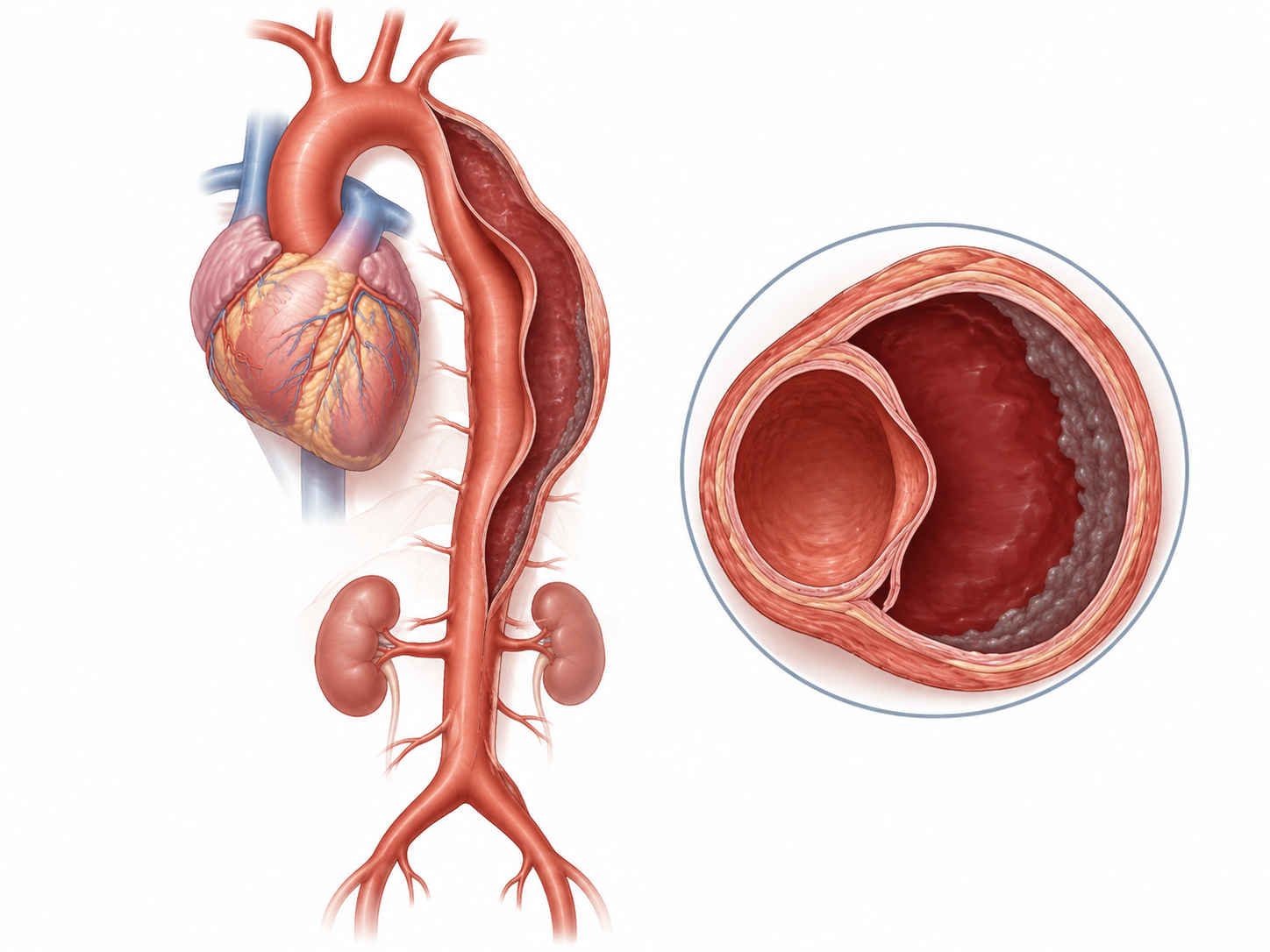
Stanford type B aortic dissection may cause mild symptoms despite extensive anatomical involvement. We report the case of a 70-year-old man with longstanding hypertension, a history of ischemic heart disease, hypothyroidism, and ventricular ectopy who reported mild lumbar pain during a cardiology assessment. Computed tomography angiography of the chest and abdomen revealed aneurysmal dilatation of the descending thoracic aorta measuring 8.05 × 7.69 cm, a proximal intimal flap, mural thrombus, possible involvement of the celiac artery origin, and extension of the dissection to both common femoral arteries. Following stabilization with intravenous antihypertensive therapy, beta-blockers, and analgesia, thoracic endovascular aortic repair was performed to cover the proximal entry tear. Clinical improvement, reduced pain and ventricular ectopy, and adequate blood pressure control were described. This case highlights the importance of considering aortic disease in patients with lumbar pain and cardiovascular risk factors, and of integrating anatomy, symptoms, and clinical status when selecting treatment.
References
1. Isselbacher EM, Preventza O, Black JH 3rd, Augoustides JG, Beck AW, Bolen MA, et al. 2022 ACC/AHA Guideline for the Diagnosis and Management of Aortic Disease: A Report of the American Heart Association/American College of Cardiology Joint Committee on Clinical Practice Guidelines. Circulation. 2022;146(24):e334-e482. doi:10.1161/CIR.0000000000001106. DOI: https://doi.org/10.1161/CIR.0000000000001097
2. Mazzolai L, Teixido-Tura G, Lanzi S, Boc V, Bossone E, Brodmann M, et al. 2024 ESC Guidelines for the management of peripheral arterial and aortic diseases. Eur Heart J. 2024;45(36):3538-3700. doi:10.1093/eurheartj/ehae179. DOI: https://doi.org/10.1093/eurheartj/ehae179
3. Zhou Z, Cecchi AC, Prakash SK, Milewicz DM. Risk Factors for Thoracic Aortic Dissection. Genes (Basel). 2022;13(10):1814. doi:10.3390/genes13101814. DOI: https://doi.org/10.3390/genes13101814
4. Umaña JP, Camacho J. Disección aórtica aguda: diagnóstico y manejo inicial. Rev Med Clin Las Condes. 2022;33(3):218-226. doi:10.1016/j.rmclc.2022.05.002. DOI: https://doi.org/10.1016/j.rmclc.2022.05.002
5. Landenhed M, Engström G, Gottsäter A, Caulfield MP, Hedblad B, Newton-Cheh C, et al. Risk profiles for aortic dissection and ruptured or surgically treated aneurysms: a prospective cohort study. J Am Heart Assoc. 2015;4(1):e001513. doi:10.1161/JAHA.114.001513. DOI: https://doi.org/10.1161/JAHA.114.001513
6. Howard C, Sheridan J, Picca L, Reza S, Smith T, Ponnapalli A, et al. TEVAR for complicated and uncomplicated type B aortic dissection—Systematic review and meta-analysis. J Card Surg. 2021;36(10):3820-3830. doi:10.1111/jocs.15827. DOI: https://doi.org/10.1111/jocs.15827
Details
License
Copyright (c) 2026 Loja Medical Journal

This work is licensed under a Creative Commons Attribution 4.0 International License.
This is an open access article distributed under the terms of the Creative Commons Attribution 4.0 International License (https://creativecommons.org/licenses/by/4.0), which permits unrestricted use, distribution, and reproduction in any medium, provided that the original work is properly cited.