Percutaneous Cholecystostomy as a Temporizing Treatment in Severe Acute Cholecystitis: When Should It Be Indicated?
Authors
Key Information
Journal
Published in Vol. 1 No. 1 (2026) of Loja Medical Journal.
About the JournalAbstract
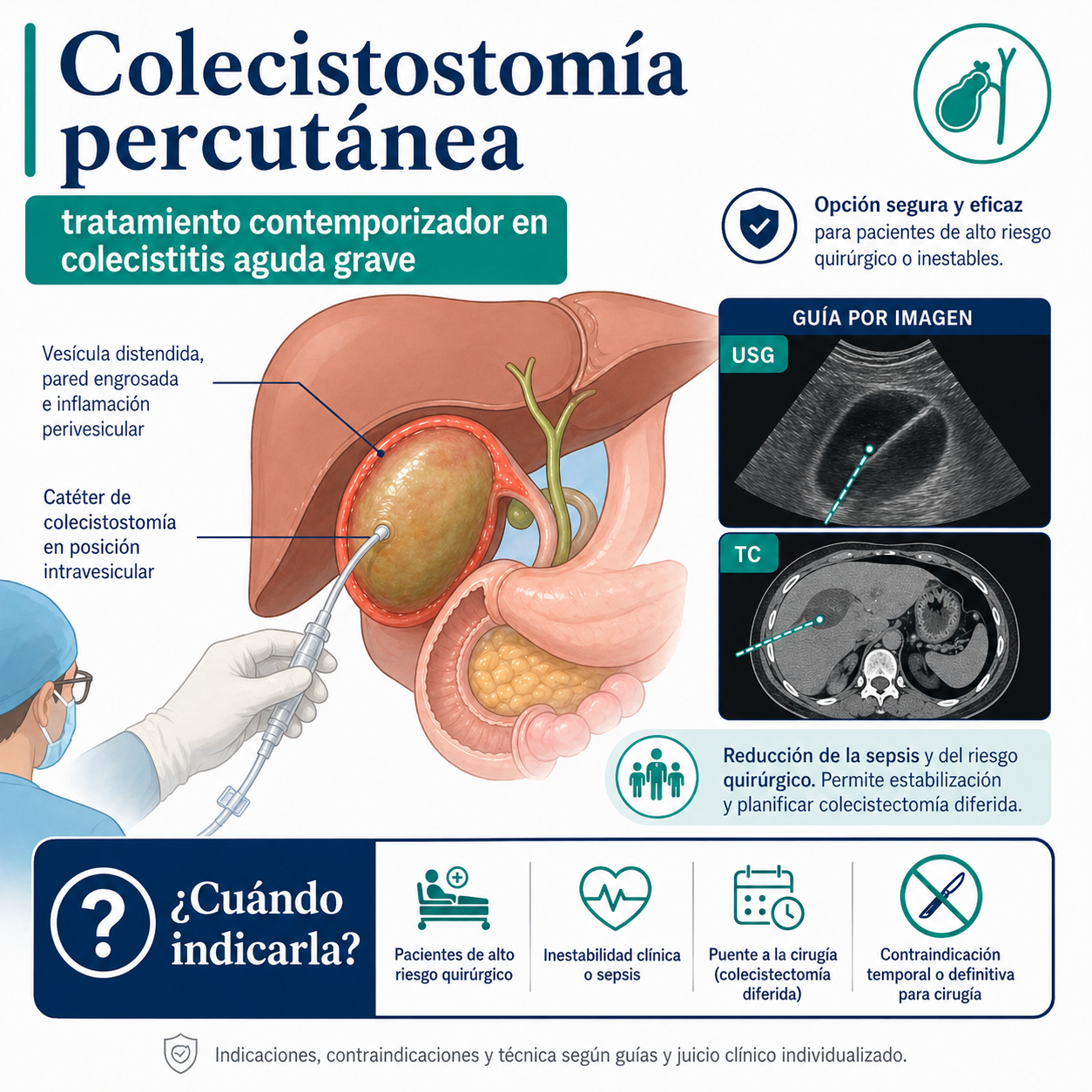
This study addresses percutaneous cholecystostomy as a treatment for severe acute cholecystitis. This technique involves draining the contents of the inflamed gallbladder through a needle guided by ultrasound or computed tomography imaging. It is mainly used in patients with high surgical risk or severe complications. Percutaneous cholecystostomy has evolved with advances in imaging techniques, assistive devices, stent placement, antibiotic use, and assessment of procedural success. It offers advantages such as a lower complication rate and faster recovery compared with open surgery. The success rate ranges from 70% to 90% and has been associated with decreased mortality and a lower risk of complications. In summary, percutaneous cholecystostomy is an effective and safe option as a temporizing treatment for severe acute cholecystitis in patients at high surgical risk.
References
1. Viste A, Jensen D, Angelsen JH, Hoem D. Percutaneous cholecystostomy in acute cholecystitis; a retrospective analysis of a large series of 104 patients. BMC Surg. 2015;15:17. doi:10.1186/s12893-015-0002-8.
2. Kim SY, Yoo KS. Efficacy of preoperative percutaneous cholecystostomy in the management of acute cholecystitis according to severity grades. Korean J Intern Med. 2018;33(3):497-505. doi:10.3904/kjim.2016.209.
3. Hasbahceci M, Cengiz MB, Malya FU, Kunduz E, Memmi N. The impact of a percutaneous cholecystostomy catheter in situ until the time of cholecystectomy on the development of recurrent acute cholecystitis: a historical cohort study. Rev Esp Enferm Dig. 2018;110(10):629-633. doi:10.17235/reed.2018.5644/2018.
4. Tsuyuguchi T, Takada T, Kawarada Y, Nimura Y, Wada K, Nagino M, et al. Techniques of biliary drainage for acute cholecystitis: Tokyo Guidelines. J Hepatobiliary Pancreat Surg. 2007;14(1):46-51. doi:10.1007/s00534-006-1155-8.
5. Markopoulos G, Mulita F, Kehagias D, Tsochatzis S, Lampropoulos C, Kehagias I. Outcomes of percutaneous cholecystostomy in elderly patients: a systematic review and meta-analysis. Prz Gastroenterol. 2021;16(3):188-195. doi:10.5114/pg.2020.100658.
6. Gurusamy KS, Rossi M, Davidson BR. Percutaneous cholecystostomy for high-risk surgical patients with acute calculous cholecystitis. Cochrane Database Syst Rev. 2013;(8):CD007088. doi:10.1002/14651858.CD007088.pub2.
7. Miura F, Takada T, Kawarada Y, Nimura Y, Wada K, Hirota M, et al. Flowcharts for the diagnosis and treatment of acute cholangitis and cholecystitis: Tokyo Guidelines. J Hepatobiliary Pancreat Surg. 2007;14(1):27-34. doi:10.1007/s00534-006-1153-x.
8. Lin WC, Chang CW, Chu CH. Percutaneous cholecystostomy for acute cholecystitis in high-risk elderly patients. Kaohsiung J Med Sci. 2016;32(10):518-525. doi:10.1016/j.kjms.2016.08.006.
9. Al-Jundi W, Cannon T, Antakia R, Anoop U, Balamurugan R, Everitt N, et al. Percutaneous cholecystostomy as an alternative to cholecystectomy in high risk patients with biliary sepsis: a district general hospital experience. Ann R Coll Surg Engl. 2012;94(2):99-101. doi:10.1308/003588412X13171221501302.
10. Yegros Ortiz CD, Feltes Villalba SC, Duarte DB, Fretes Oviedo NE. Application of Tokyo criteria for the diagnosis of acute cholecystitis in the Adult Emergency Department of the Hospital Nacional, Itauguá. Rev Nac (Itauguá). 2021;13(1):31-40. doi:10.18004/rdn2021.jun.01.031.040.
11. Tsuyuguchi T, Takada T, Kawarada Y, Nimura Y, Wada K, Nagino M, et al. Techniques of biliary drainage for acute cholangitis: Tokyo Guidelines. J Hepatobiliary Pancreat Surg. 2007;14(1):35-45. doi:10.1007/s00534-006-1154-9.
12. Itoi T, Tsuyuguchi T, Takada T, Strasberg SM, Pitt HA, Kim MH, et al. TG13 indications and techniques for biliary drainage in acute cholangitis (with videos). J Hepatobiliary Pancreat Sci. 2013;20(1):71-80. doi:10.1007/s00534-012-0569-8.
13. Nassar A, Elshahat I, Forsyth K, Shaikh S, Ghazanfar M. Outcome of early cholecystectomy compared to percutaneous drainage of gallbladder and delayed cholecystectomy for patients with acute cholecystitis: systematic review and meta-analysis. HPB (Oxford). 2022;24(10):1622-1633. doi:10.1016/j.hpb.2022.04.010.
14. Hung YL, Sung CM, Fu CY, Liao CH, Wang SY, Hsu JT, et al. Management of patients with acute cholecystitis after percutaneous cholecystostomy: from the acute stage to definitive surgical treatment. Front Surg. 2021;8:616320. doi:10.3389/fsurg.2021.616320.
15. Sanjay P, Mittapalli D, Marioud A, White RD, Ram R, Alijani A. Clinical outcomes of a percutaneous cholecystostomy for acute cholecystitis: a multicentre analysis. HPB (Oxford). 2013;15(7):511-516. doi:10.1111/j.1477-2574.2012.00610.x.
16. Ramos Loza CM, Mendoza López Videla JN, Ponce Morales JA. Aplicación de la guía TOKIO en colecistitis aguda litiásica. Rev Méd La Paz. 2018;24(1):19-26.
17. Mori Y, Itoi T, Baron TH, Takada T, Strasberg SM, Pitt HA, et al. Tokyo Guidelines 2018: management strategies for gallbladder drainage in patients with acute cholecystitis (with videos). J Hepatobiliary Pancreat Sci. 2018;25(1):87-95. doi:10.1002/jhbp.504.
18. Ito K, Fujita N, Noda Y, Kobayashi G, Kimura K, Sugawara T, et al. Percutaneous cholecystostomy versus gallbladder aspiration for acute cholecystitis: a prospective randomized controlled trial. AJR Am J Roentgenol. 2004;183(1):193-196. doi:10.2214/ajr.183.1.1830193.
Details
License
Copyright (c) 2026 Loja Medical Journal

This work is licensed under a Creative Commons Attribution 4.0 International License.
This is an open access article distributed under the terms of the Creative Commons Attribution 4.0 International License (https://creativecommons.org/licenses/by/4.0), which permits unrestricted use, distribution, and reproduction in any medium, provided that the original work is properly cited.