
Current Management of Complicated Acute Cholecystitis: A Literature Review of Surgical and Minimally Invasive Strategies
Authors
Key Information
Journal

Published in Vol. 1 No. 1 (2026) of Loja Medical Journal.
About the JournalAbstract
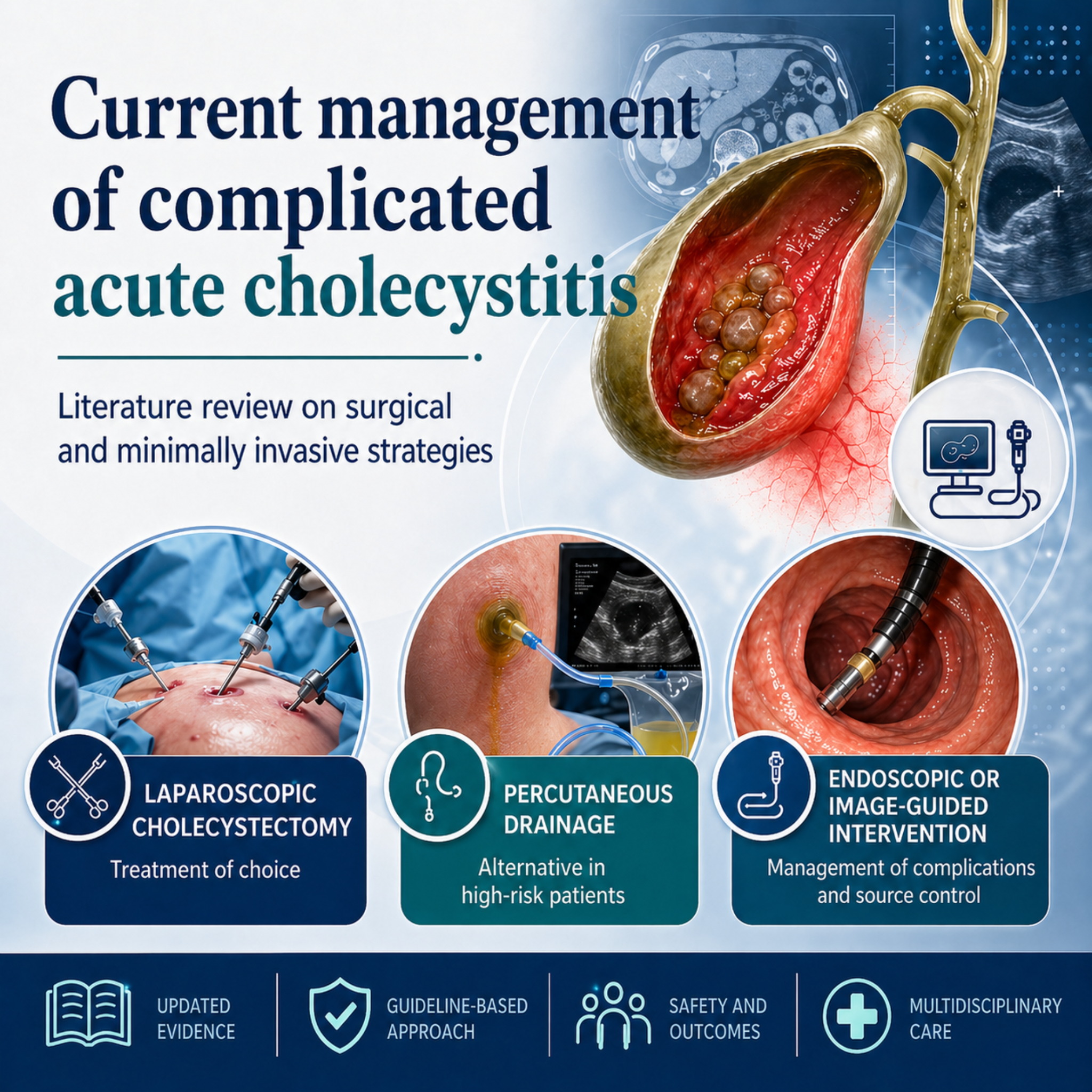
Introduction: Complicated acute cholecystitis represents a spectrum of inflammatory and infectious disease of the gallbladder that includes gangrenous, emphysematous, perforated, empyematous, acalculous forms, as well as cases associated with abscesses, biliary peritonitis, or sepsis. Its management requires timely diagnosis, severity stratification, rational antibiotic therapy, and early source control. Objective: To synthesize the evidence published between 2021 and 2026 on the contemporary management of complicated acute cholecystitis, with emphasis on surgical and minimally invasive strategies. Methods: A narrative literature review was conducted using articles indexed in PubMed/MEDLINE, PMC, JAMA Network, EClinicalMedicine, SpringerLink, and ScienceDirect, prioritizing systematic reviews, meta-analyses, international consensus statements, recent clinical guidelines, and high-impact narrative review. Results: Early laparoscopic cholecystectomy during the index admission remains the treatment of choice in patients with sufficient physiological reserve. In cases of a difficult gallbladder, bailout strategies, particularly subtotal cholecystectomy, reduce the risk of bile duct injury when achieving the critical view of safety is not possible. In patients at high surgical risk, percutaneous cholecystostomy continues to play a relevant role as a bridge to definitive treatment or as selected definitive therapy; however, recent evidence favors cholecystectomy when the patient can tolerate it. Endoscopic ultrasound-guided gallbladder drainage is emerging as an effective alternative in centers with advanced expertise. Conclusions: Current management should be individualized through a multidisciplinary approach that integrates clinical severity, anesthetic risk, biliary anatomy, technological availability, and team expertise. The therapeutic priority is source control with the lowest possible morbidity.
References
1. Gallaher JR, Charles A. Acute cholecystitis: a review. JAMA. 2022;327(10):965-975. doi:10.1001/jama.2022.2350.
2. Mencarini L, Vestito A, Zagari RM, Montagnani M, Varotti E, Dajti E, et al. The diagnosis and treatment of acute cholecystitis: a comprehensive narrative review for a practical approach. J Clin Med. 2024;13(9):2695. doi:10.3390/jcm13092695.
3. Fugazzola P, Ceresoli M, Catena F, Ansaloni L, Sartelli M, Coccolini F, et al. Clinical update on acute cholecystitis and biliary pancreatitis: between certainties and grey areas. EClinicalMedicine. 2024;77:102880. doi:10.1016/j.eclinm.2024.102880.
4. Wu H, Liao B, Cao T, Ji T, Huang J, Luo Y, et al. Comparison of the safety profile, conversion rate and hospitalization duration between early and delayed laparoscopic cholecystectomy for acute cholecystitis: a systematic review and meta-analysis. Front Med (Lausanne). 2023;10:1185482. doi:10.3389/fmed.2023.1185482.
5. Kourounis G, Rooke ZC, McGuigan M, Georgiades F. Systematic review and meta-analysis of early versus late interval laparoscopic cholecystectomy following percutaneous cholecystostomy. HPB (Oxford). 2022;24(9):1405-1415. doi:10.1016/j.hpb.2022.03.016.
6. Toro A, Teodoro M, Khan M, Schembari E, Di Saverio S, Catena F, et al. Subtotal cholecystectomy for difficult acute cholecystitis: how to finalize safely by laparoscopy-a systematic review. World J Emerg Surg. 2021;16(1):45. doi:10.1186/s13017-021-00392-x.
7. Abdallah HS, Sedky MH, Sedky ZH. The difficult laparoscopic cholecystectomy: a narrative review. BMC Surg. 2025;25:156. doi:10.1186/s12893-025-02847-3.
8. Hajibandeh S, Hajibandeh S, Parente A, Laing RW, Bartlett D, Athwal TS, et al. Meta-analysis of fenestrating versus reconstituting subtotal cholecystectomy in the management of difficult gallbladder. HPB (Oxford). 2024;26(1):8-20. doi:10.1016/j.hpb.2023.09.005.
9. Ravendran K, Mohan BP, Dhindsa BS, Mashiana HS, Ponnada S, Chandan S, et al. Fenestrating versus reconstituting subtotal cholecystectomy: systematic review and meta-analysis on bile leak, bile duct injury, and outcomes. Cureus. 2024;16(10):e72769. doi:10.7759/cureus.72769.
10. Cirocchi R, Amabile MI, De Sol A, Catena F, Di Saverio S, Birindelli A, et al. Management of acute cholecystitis in high-risk patients: percutaneous gallbladder drainage as a definitive treatment versus emergency cholecystectomy-systematic review and meta-analysis. J Clin Med. 2023;12(15):4903. doi:10.3390/jcm12154903.
11. Fanciulli G, Favara G, Maugeri A, Barchitta M, Agodi A, Basile G. Comparing percutaneous treatment and cholecystectomy outcomes in acute cholecystitis patients: a systematic review and meta-analysis. World J Emerg Surg. 2025;20:50. doi:10.1186/s13017-025-00622-6.
12. Sadaka AH, Tseng JF, Itani KMF. Indications for and optimal management of percutaneous cholecystostomy drainage: a systematic review. JAMA Surg. 2025;160(12):1368-1377. doi:10.1001/jamasurg.2025.3260.
13. Pesce A, Ramirez-Giraldo C, Arkoudis NA, Ramsay G, Popivanov G, Gurusamy K, et al. Management of high-surgical-risk patients with acute cholecystitis following percutaneous cholecystostomy: results of an international Delphi consensus study. Int J Surg. 2025;111(5):3185-3192. doi:10.1097/JS9.0000000000002325.
14. Koushesh P, Ayaz T, Tullius T. Percutaneous cholecystostomy: procedural guidance and future directions for clinical management. Semin Intervent Radiol. 2024;41(5):460-465. doi:10.1055/s-0044-1791724.
15. Irani SS, Sharzehi K, Siddiqui UD. AGA clinical practice update on role of EUS-guided gallbladder drainage in acute cholecystitis: commentary. Clin Gastroenterol Hepatol. 2023;21(5):1141-1147. doi:10.1016/j.cgh.2022.12.039.
16. Manudhane AP, Umair M, Yasir M, Abu-Arja MH, Bekkali NLH, Binmoeller KF. A review on endoscopic management of acute cholecystitis: EUS-GBD and ETGBD. Medicina (Kaunas). 2024;60(2):212. doi:10.3390/medicina60020212.
17. Jandura DM, Puli SR. Efficacy and safety of endoscopic transpapillary gallbladder drainage in acute cholecystitis: an updated meta-analysis. World J Gastrointest Endosc. 2021;13(8):345-355. doi:10.4253/wjge.v13.i8.345.
18. Fico V, La Greca A, Tropeano G, Di Grezia M, Chiarello MM, Brisinda G, et al. Updates on antibiotic regimens in acute cholecystitis. Medicina (Kaunas). 2024;60(7):1040. doi:10.3390/medicina60071040.
19. Colling KP, Besshoff KE, Forrester JD, Huston JM. Surgical Infection Society guidelines for antibiotic use in patients undergoing cholecystectomy for gallbladder disease. Surg Infect (Larchmt). 2022;23(4):339-350. doi:10.1089/sur.2021.227.
20. de'Angelis N, Catena F, Memeo R, Coccolini F, Martinez-Perez A, Romeo OM, et al. 2020 WSES guidelines for the detection and management of bile duct injury during cholecystectomy. World J Emerg Surg. 2021;16(1):30. doi:10.1186/s13017-021-00369-w.
21. Tang J, Wu T, Yang L, Pan Y, Zou Z, Zhang X. A meta-analysis of the efficacy and safety of indocyanine green fluorescence imaging-guided laparoscopic cholecystectomy. Photodiagnosis Photodyn Ther. 2025;105245. doi:10.1016/j.pdpdt.2025.105245.
22. Lie H, Cho J, Hong T, Lim S, Kim KH. Efficacy and safety of near-infrared fluorescence cholangiography using indocyanine green in laparoscopic cholecystectomy: a systematic review and meta-analysis. J Laparoendosc Adv Surg Tech A. 2023;33(5):434-446. doi:10.1089/lap.2022.0495.
23. Kolokotronis T, Petropoulou Z, Daskalaki D, Tzovaras G. Interventional management of acute perforated cholecystitis. World J Gastrointest Surg. 2026;18(1):114059. doi:10.4240/wjgs.v18.i1.114059.
Details
License
Copyright (c) 2026 Loja Medical Journal

This work is licensed under a Creative Commons Attribution 4.0 International License.
This is an open access article distributed under the terms of the Creative Commons Attribution 4.0 International License (https://creativecommons.org/licenses/by/4.0), which permits unrestricted use, distribution, and reproduction in any medium, provided that the original work is properly cited.