
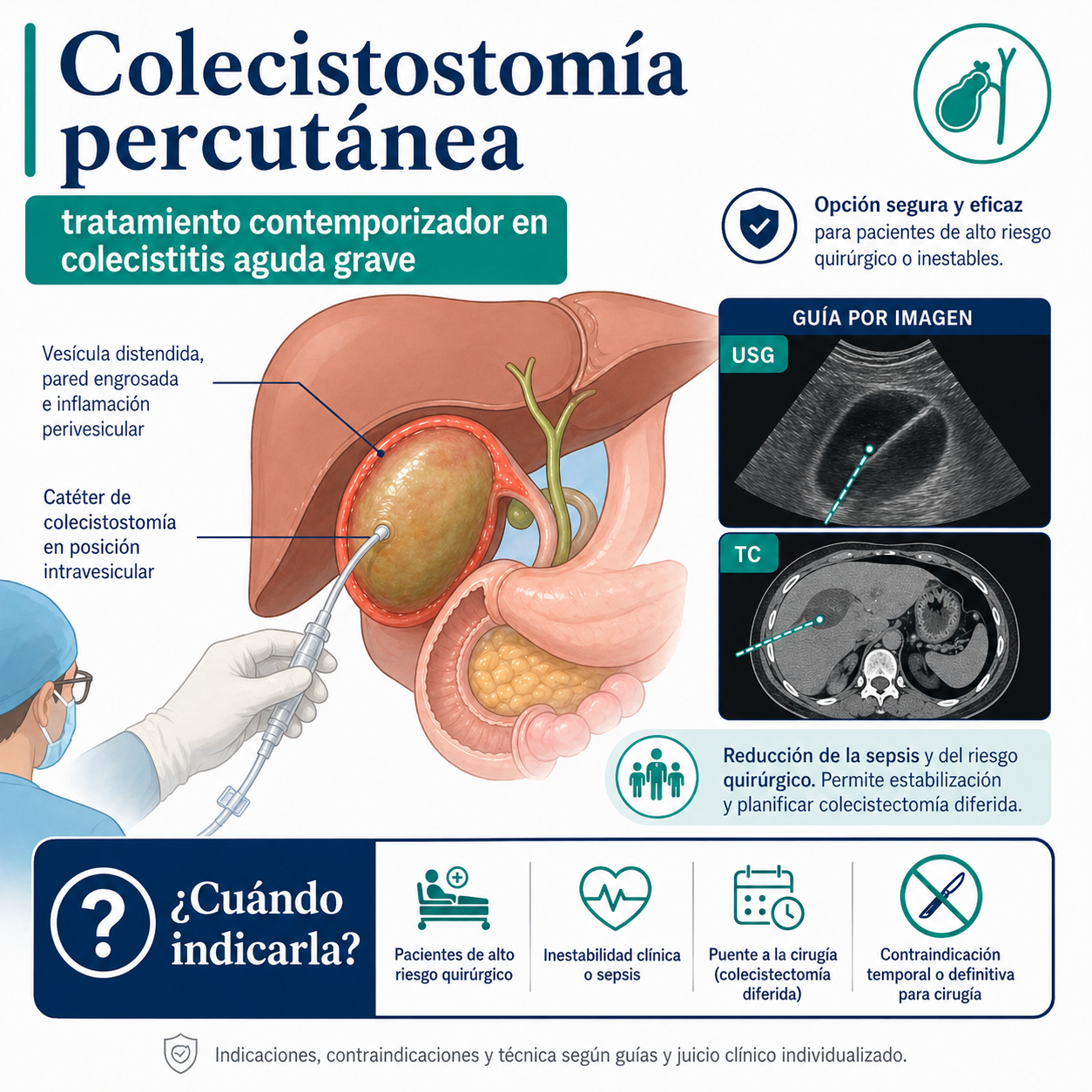
Colecistostomía percutánea como tratamiento contemporizador en colecistitis aguda grave: ¿cuándo indicarla?
Autores/as
Información clave
Revista
Publicado en Vol. 1 Núm. 1 (2026) de Revista Médica de Loja.
Sobre la revistaResumen
La presente investigación aborda el tema de la Colecistostomía percutánea como tratamiento para la colecistitis aguda grave. Esta técnica consiste en drenar el contenido de la vesícula biliar inflamada a través de una aguja guiada por imágenes de ultrasonido o tomografía computarizada. Se utiliza principalmente en pacientes con alto riesgo quirúrgico o complicaciones graves. La Colecistostomía percutánea ha evolucionado con avances en técnicas de imagen, dispositivos de asistencia, colocación de stent, uso de antibióticos y evaluación del éxito del procedimiento. Ofrece ventajas como una menor tasa de complicaciones y una recuperación más rápida en comparación con la cirugía abierta. La tasa de éxito varía entre el 70 % y el 90 %, y se ha asociado con una disminución de la mortalidad y un menor riesgo de complicaciones. En resumen, la Colecistostomía percutánea es una opción efectiva y segura como tratamiento contemporizador para tratar la colecistitis aguda grave en pacientes de alto riesgo quirúrgico.
Referencias
1. Viste A, Jensen D, Angelsen JH, Hoem D. Percutaneous cholecystostomy in acute cholecystitis; a retrospective analysis of a large series of 104 patients. BMC Surg. 2015;15:17. doi:10.1186/s12893-015-0002-8.
2. Kim SY, Yoo KS. Efficacy of preoperative percutaneous cholecystostomy in the management of acute cholecystitis according to severity grades. Korean J Intern Med. 2018;33(3):497-505. doi:10.3904/kjim.2016.209.
3. Hasbahceci M, Cengiz MB, Malya FU, Kunduz E, Memmi N. The impact of a percutaneous cholecystostomy catheter in situ until the time of cholecystectomy on the development of recurrent acute cholecystitis: a historical cohort study. Rev Esp Enferm Dig. 2018;110(10):629-633. doi:10.17235/reed.2018.5644/2018.
4. Tsuyuguchi T, Takada T, Kawarada Y, Nimura Y, Wada K, Nagino M, et al. Techniques of biliary drainage for acute cholecystitis: Tokyo Guidelines. J Hepatobiliary Pancreat Surg. 2007;14(1):46-51. doi:10.1007/s00534-006-1155-8.
5. Markopoulos G, Mulita F, Kehagias D, Tsochatzis S, Lampropoulos C, Kehagias I. Outcomes of percutaneous cholecystostomy in elderly patients: a systematic review and meta-analysis. Prz Gastroenterol. 2021;16(3):188-195. doi:10.5114/pg.2020.100658.
6. Gurusamy KS, Rossi M, Davidson BR. Percutaneous cholecystostomy for high-risk surgical patients with acute calculous cholecystitis. Cochrane Database Syst Rev. 2013;(8):CD007088. doi:10.1002/14651858.CD007088.pub2.
7. Miura F, Takada T, Kawarada Y, Nimura Y, Wada K, Hirota M, et al. Flowcharts for the diagnosis and treatment of acute cholangitis and cholecystitis: Tokyo Guidelines. J Hepatobiliary Pancreat Surg. 2007;14(1):27-34. doi:10.1007/s00534-006-1153-x.
8. Lin WC, Chang CW, Chu CH. Percutaneous cholecystostomy for acute cholecystitis in high-risk elderly patients. Kaohsiung J Med Sci. 2016;32(10):518-525. doi:10.1016/j.kjms.2016.08.006.
9. Al-Jundi W, Cannon T, Antakia R, Anoop U, Balamurugan R, Everitt N, et al. Percutaneous cholecystostomy as an alternative to cholecystectomy in high risk patients with biliary sepsis: a district general hospital experience. Ann R Coll Surg Engl. 2012;94(2):99-101. doi:10.1308/003588412X13171221501302.
10. Yegros Ortiz CD, Feltes Villalba SC, Duarte DB, Fretes Oviedo NE. Application of Tokyo criteria for the diagnosis of acute cholecystitis in the Adult Emergency Department of the Hospital Nacional, Itauguá. Rev Nac (Itauguá). 2021;13(1):31-40. doi:10.18004/rdn2021.jun.01.031.040.
11. Tsuyuguchi T, Takada T, Kawarada Y, Nimura Y, Wada K, Nagino M, et al. Techniques of biliary drainage for acute cholangitis: Tokyo Guidelines. J Hepatobiliary Pancreat Surg. 2007;14(1):35-45. doi:10.1007/s00534-006-1154-9.
12. Itoi T, Tsuyuguchi T, Takada T, Strasberg SM, Pitt HA, Kim MH, et al. TG13 indications and techniques for biliary drainage in acute cholangitis (with videos). J Hepatobiliary Pancreat Sci. 2013;20(1):71-80. doi:10.1007/s00534-012-0569-8.
13. Nassar A, Elshahat I, Forsyth K, Shaikh S, Ghazanfar M. Outcome of early cholecystectomy compared to percutaneous drainage of gallbladder and delayed cholecystectomy for patients with acute cholecystitis: systematic review and meta-analysis. HPB (Oxford). 2022;24(10):1622-1633. doi:10.1016/j.hpb.2022.04.010.
14. Hung YL, Sung CM, Fu CY, Liao CH, Wang SY, Hsu JT, et al. Management of patients with acute cholecystitis after percutaneous cholecystostomy: from the acute stage to definitive surgical treatment. Front Surg. 2021;8:616320. doi:10.3389/fsurg.2021.616320.
15. Sanjay P, Mittapalli D, Marioud A, White RD, Ram R, Alijani A. Clinical outcomes of a percutaneous cholecystostomy for acute cholecystitis: a multicentre analysis. HPB (Oxford). 2013;15(7):511-516. doi:10.1111/j.1477-2574.2012.00610.x.
16. Ramos Loza CM, Mendoza López Videla JN, Ponce Morales JA. Aplicación de la guía TOKIO en colecistitis aguda litiásica. Rev Méd La Paz. 2018;24(1):19-26.
17. Mori Y, Itoi T, Baron TH, Takada T, Strasberg SM, Pitt HA, et al. Tokyo Guidelines 2018: management strategies for gallbladder drainage in patients with acute cholecystitis (with videos). J Hepatobiliary Pancreat Sci. 2018;25(1):87-95. doi:10.1002/jhbp.504.
18. Ito K, Fujita N, Noda Y, Kobayashi G, Kimura K, Sugawara T, et al. Percutaneous cholecystostomy versus gallbladder aspiration for acute cholecystitis: a prospective randomized controlled trial. AJR Am J Roentgenol. 2004;183(1):193-196. doi:10.2214/ajr.183.1.1830193.
Detalles
Licencia
Derechos de autor 2026 Revista Médica de Loja

Esta obra está bajo una licencia internacional Creative Commons Atribución 4.0.
Este es un artículo en acceso abierto, distribuido bajo los términos de una licencia Creative Commons (https://creativecommons.org/licenses/by/4.0) que permite el uso, distribución y reproducción en cualquier medio siempre que la obra original sea correctamente citada.