
Lesiones Musculoesqueléticas en un equipo profesional de fútbol ecuatoriano: estudio retrospectivo 2022–2025
Autores/as
Información clave
Revista
Publicado en Vol. 1 Núm. 1 (2026) de Revista Médica de Loja.
Sobre la revistaResumen
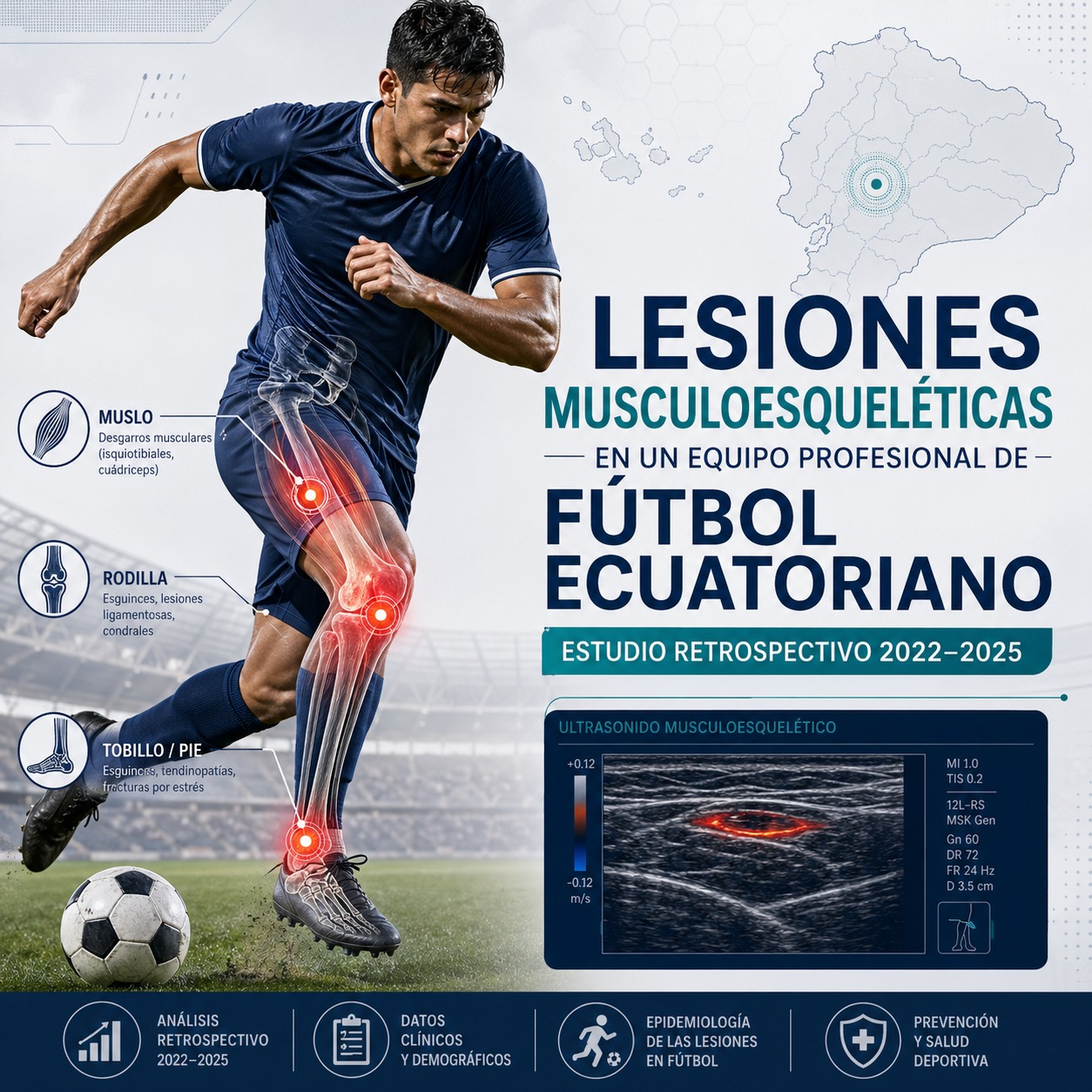
Introducción: el fútbol profesional conlleva un alto riesgo de lesiones, especialmente de lesiones musculares del miembro inferior, por lo que es necesario reforzar la vigilancia epidemiológica y los procesos diagnósticos en cada club. Objetivo: determinar la frecuencia y distribución de las lesiones musculoesqueléticas más frecuentes en deportistas de alto rendimiento de un equipo profesional de fútbol de Ecuador durante las temporadas 2022–2025. Métodos: se realizó un estudio observacional, descriptivo, retrospectivo y de corte transversal. Se analizaron 41 registros clínico-imagenológicos anonimizados de jugadores evaluados entre marzo de 2022 y diciembre de 2025. Las variables analizadas fueron edad, método diagnóstico por imagen, diagnóstico, región anatómica afectada y tipo de lesión. Se efectuó un análisis estadístico descriptivo mediante frecuencias absolutas, porcentajes, media, desviación estándar, mediana y rango. Dado que la matriz no incluía horas de exposición, no fue posible calcular tasas de incidencia por 1000 horas de práctica o competición. Resultados: la edad media fue de 25,6 ± 3,6 años (mediana: 25; rango: 19–37). El grupo de 23 a 26 años concentró el 51,2 % de los registros. La ecografía fue el método diagnóstico más utilizado (90,2 %), mientras que la radiografía representó el 9,8 %. La región anatómica más afectada fue el muslo (56,1 %), seguida de la rodilla (17,1 %) y el tobillo/pie (12,2 %). Las lesiones musculares constituyeron el principal tipo de lesión (63,4 %), seguidas de las lesiones ligamentarias y articulares inflamatorias (9,8 % cada una). Entre las lesiones musculares, los compromisos del cuádriceps/muslo anterior y del semitendinoso/isquiotibiales fueron los más frecuentes (26,9 % cada uno del total de lesiones musculares). Conclusiones: en este equipo profesional ecuatoriano predominó un patrón de lesiones centrado en el muslo y en las lesiones musculares, con amplio uso de la ecografía como herramienta diagnóstica inicial. Los resultados respaldan la necesidad de reforzar estrategias preventivas dirigidas al muslo anterior, los isquiotibiales, los aductores y la rodilla medial, así como de estandarizar la vigilancia con variables de exposición, tiempo de baja y recurrencia.
Referencias
1. Ekstrand J, Hägglund M, Waldén M. Injury incidence and injury patterns in professional football: the UEFA injury study. Br J Sports Med. 2011;45(7):553-558. doi:10.1136/bjsm.2009.060582.
2. Ekstrand J, Hägglund M, Waldén M. Epidemiology of muscle injuries in professional football (soccer). Am J Sports Med. 2011;39(6):1226-1232. doi:10.1177/0363546510395879.
3. López-Valenciano A, Ruiz-Pérez I, Garcia-Gómez A, Vera-Garcia FJ, De Ste Croix M, Myer GD, et al. Epidemiology of injuries in professional football: a systematic review and meta-analysis. Br J Sports Med. 2020;54(12):711-718. doi:10.1136/bjsports-2018-099577.
4. Ekstrand J, Bengtsson H, Waldén M, Davison M, Khan KM, Hägglund M. Hamstring injury rates have increased during recent seasons and now constitute 24% of all injuries in men's professional football: the UEFA Elite Club Injury Study from 2001/02 to 2021/22. Br J Sports Med. 2023;57(5):292-298. doi:10.1136/bjsports-2021-105407.
5. Waldén M, Mountjoy M, McCall A, Serner A, Massey A, Tol JL, et al. Football-specific extension of the IOC consensus statement: methods for recording and reporting of epidemiological data on injury and illness in sport 2020. Br J Sports Med. 2023;57(21):1341-1350. doi:10.1136/bjsports-2022-106405.
6. Bahr R, Clarsen B, Derman W, Dvorak J, Emery CA, Finch CF, et al. International Olympic Committee consensus statement: methods for recording and reporting of epidemiological data on injury and illness in sport 2020 (including STROBE Extension for Sport Injury and Illness Surveillance [STROBE-SIIS]). Br J Sports Med. 2020;54(7):372-389. doi:10.1136/bjsports-2019-101969.
7. Fuller CW, Ekstrand J, Junge A, Andersen TE, Bahr R, Dvorak J, Hägglund M, et al. Consensus statement on injury definitions and data collection procedures in studies of football (soccer) injuries. Br J Sports Med. 2006;40(3):193-201. doi:10.1136/bjsm.2005.025270.
8. Hägglund M, Waldén M, Bahr R, Ekstrand J. Methods for epidemiological study of injuries to professional football players: developing the UEFA model. Br J Sports Med. 2005;39(6):340-346. doi:10.1136/bjsm.2005.018267.
9. Guermazi A, Roemer FW, Robinson P, Tol JL, Regatte RR, Crema MD. Imaging of muscle injuries in sports medicine: Sports Imaging Series. Radiology. 2017;282(3):646-663. doi:10.1148/radiol.2017160267.
10. Crema MD, Yamada AF, Guermazi A, Roemer FW, Skaf AY. Imaging techniques for muscle injury in sports medicine and clinical relevance. Curr Rev Musculoskelet Med. 2015;8(2):154-161. doi:10.1007/s12178-015-9260-4.
11. Peetrons P. Ultrasound of muscles. Eur Radiol. 2002;12(1):35-43. doi:10.1007/s00330-001-1164-6.
12. Pedret C. Hamstring muscle injuries: MRI and ultrasound for diagnosis and prognosis. J Belg Soc Radiol. 2022;105(1):91. doi:10.5334/jbsr.2617.
13. Lee JC, Healy J. Sonography of lower limb muscle injury. AJR Am J Roentgenol. 2004;182(2):341-351. doi:10.2214/ajr.182.2.1820341.
14. Mueller-Wohlfahrt HW, Haensel L, Mithoefer K, Ekstrand J, English B, McNally S, et al. Terminology and classification of muscle injuries in sport: the Munich consensus statement. Br J Sports Med. 2013;47(6):342-350. doi:10.1136/bjsports-2012-091448.
15. Pollock N, James SLJ, Lee JC, Chakraverty R. British athletics muscle injury classification: a new grading system. Br J Sports Med. 2014;48(18):1347-1351. doi:10.1136/bjsports-2013-093302.
16. Mendiguchia J, Alentorn-Geli E, Idoate F, Myer GD. Rectus femoris muscle injuries in football: a clinically relevant review of mechanisms of injury, risk factors and preventive strategies. Br J Sports Med. 2013;47(6):359-366. doi:10.1136/bjsports-2012-091250.
17. Jokela A, Mechó S, Pasta G, Pleshkov P, García-Romero-Pérez A, Mazzoni S, Kosola J, et al. Indirect rectus femoris injury mechanisms in professional soccer players: video analysis and magnetic resonance imaging findings. Clin J Sport Med. 2023;33(5):475-482. doi:10.1097/JSM.0000000000001131.
18. Waldén M, Hägglund M, Ekstrand J. The epidemiology of groin injury in senior football: a systematic review of prospective studies. Br J Sports Med. 2015;49(12):792-797. doi:10.1136/bjsports-2015-094705.
19. Werner J, Hägglund M, Ekstrand J, Waldén M. Hip and groin time-loss injuries decreased slightly but injury burden remained constant in men's professional football: the 15-year prospective UEFA Elite Club Injury Study. Br J Sports Med. 2019;53(9):539-546. doi:10.1136/bjsports-2017-097796.
20. Serner A, Weir A, Tol JL, Thorborg K, Lanzinger S, Otten R, Hölmich P. Return to sport after criteria-based rehabilitation of acute adductor injuries in male athletes: a prospective cohort study. Orthop J Sports Med. 2020;8(1):2325967119897247. doi:10.1177/2325967119897247.
21. Lundblad M, Waldén M, Magnusson H, Karlsson J, Ekstrand J. The UEFA injury study: 11-year data concerning 346 MCL injuries and time to return to play. Br J Sports Med. 2013;47(12):759-762. doi:10.1136/bjsports-2013-092305.
22. Ekstrand J, Krutsch W, Spreco A, van Zoest W, Roberts C, Meyer T, Bengtsson H. Time before return to play for the most common injuries in professional football: a 16-year follow-up of the UEFA Elite Club Injury Study. Br J Sports Med. 2020;54(7):421-426. doi:10.1136/bjsports-2019-100666.
23. van Dyk N, Behan FP, Whiteley R. Including the Nordic hamstring exercise in injury prevention programmes halves the rate of hamstring injuries: a systematic review and meta-analysis of 8459 athletes. Br J Sports Med. 2019;53(21):1362-1370. doi:10.1136/bjsports-2018-100045.
24. Harøy J, Clarsen B, Wiger EG, Øyen MG, Serner A, Thorborg K, Hölmich P, Andersen TE, Bahr R. The Adductor Strengthening Programme prevents groin problems among male football players: a cluster-randomised controlled trial. Br J Sports Med. 2019;53(3):150-157. doi:10.1136/bjsports-2017-098937.
25. Thorborg K, Krommes KK, Esteve E, Clausen MB, Bartels EM, Rathleff MS. Effect of specific exercise-based football injury prevention programmes on the overall injury rate in football: a systematic review and meta-analysis of the FIFA 11 and 11+ programmes. Br J Sports Med. 2017;51(7):562-571. doi:10.1136/bjsports-2016-097066.
26. Bourne MN, Williams M, Jackson J, Williams KL, Timmins RG, Pizzari T. Preseason hip/groin strength and HAGOS scores are associated with subsequent injury in professional male soccer players. J Orthop Sports Phys Ther. 2020;50(5):234-242. doi:10.2519/jospt.2020.9022.
Detalles
Licencia
Derechos de autor 2026 Revista Médica de Loja

Esta obra está bajo una licencia internacional Creative Commons Atribución 4.0.
Este es un artículo en acceso abierto, distribuido bajo los términos de una licencia Creative Commons (https://creativecommons.org/licenses/by/4.0) que permite el uso, distribución y reproducción en cualquier medio siempre que la obra original sea correctamente citada.