Musculoskeletal Injuries in an Ecuadorian Professional Soccer Team: A Retrospective Study (2022–2025)
Authors
Key Information
Journal
Published in Vol. 1 No. 1 (2026) of Loja Medical Journal.
About the JournalAbstract
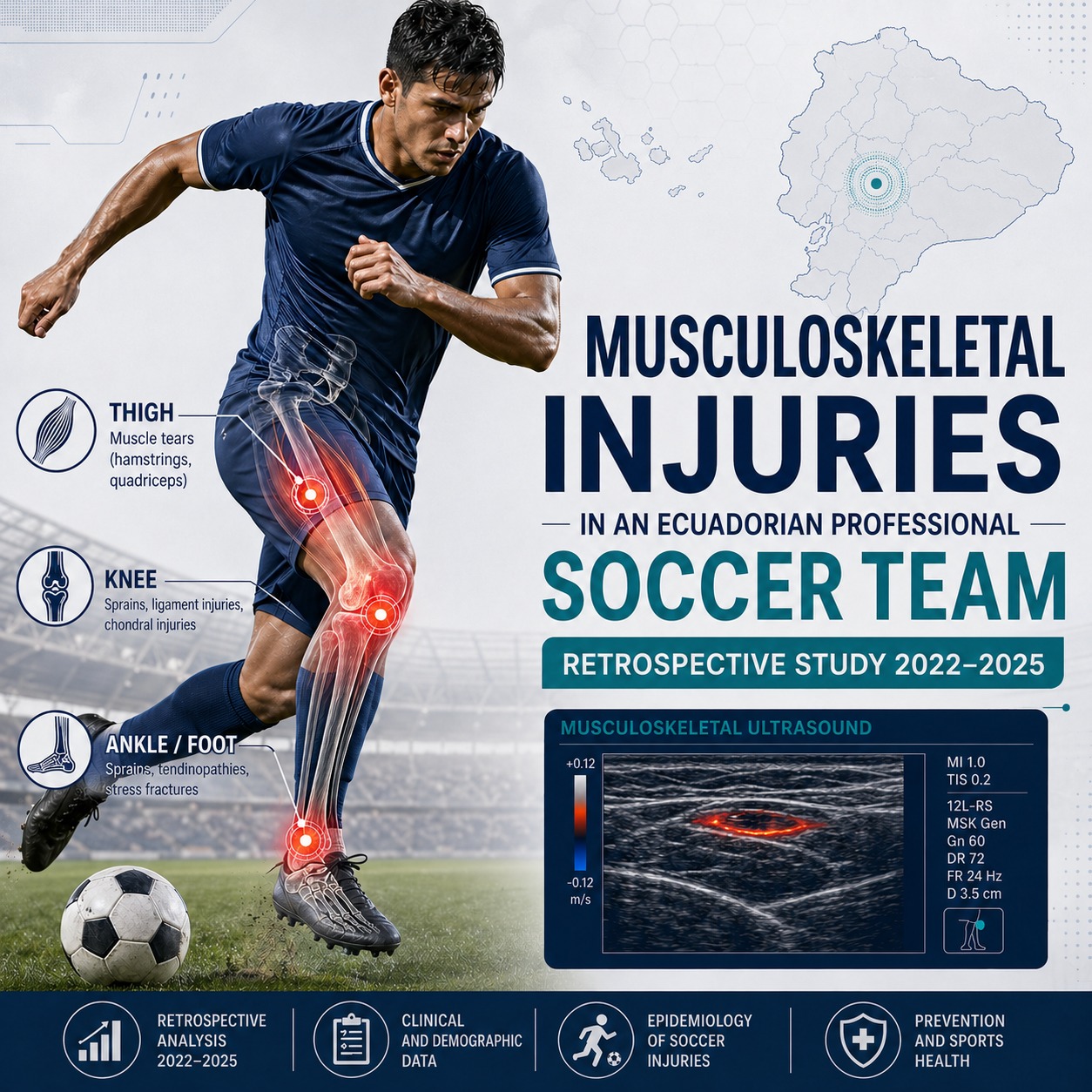
Introduction: Professional football is associated with a high risk of injury, particularly lower-limb muscle injuries; therefore, epidemiological surveillance and diagnostic processes should be strengthened within each club. Objective: To determine the frequency and distribution of the most common musculoskeletal injuries in high-performance athletes from a professional football team in Ecuador during the 2022–2025 seasons. Methods: An observational, descriptive, retrospective, cross-sectional study was conducted. Forty-one anonymized clinical-imaging records of players evaluated between March 2022 and December 2025 were analyzed. The variables assessed were age, imaging diagnostic method, diagnosis, affected anatomical region, and type of injury. Descriptive statistical analysis was performed using absolute frequencies, percentages, mean, standard deviation, median, and range. Since the dataset did not include exposure hours, it was not possible to calculate incidence rates per 1000 hours of training or competition. Results: The mean age was 25.6 ± 3.6 years (median: 25; range: 19–37). The 23–26-year age group accounted for 51.2% of the records. Ultrasonography was the most frequently used diagnostic method (90.2%), whereas radiography accounted for 9.8%. The most affected anatomical region was the thigh (56.1%), followed by the knee (17.1%) and the ankle/foot (12.2%). Muscle injuries were the main type of injury (63.4%), followed by ligamentous and inflammatory joint injuries (9.8% each). Among muscle injuries, quadriceps/anterior thigh and semitendinosus/hamstring involvement were the most frequent findings, each accounting for 26.9% of all muscle injuries. Conclusions: In this Ecuadorian professional football team, injuries predominantly involved the thigh and were mainly muscular, with extensive use of ultrasonography as an initial diagnostic tool. These findings support the need to strengthen preventive strategies targeting the anterior thigh, hamstrings, adductors, and medial knee, as well as to standardize surveillance using exposure, time-loss, and recurrence variables.
References
1. Ekstrand J, Hägglund M, Waldén M. Injury incidence and injury patterns in professional football: the UEFA injury study. Br J Sports Med. 2011;45(7):553-558. doi:10.1136/bjsm.2009.060582.
2. Ekstrand J, Hägglund M, Waldén M. Epidemiology of muscle injuries in professional football (soccer). Am J Sports Med. 2011;39(6):1226-1232. doi:10.1177/0363546510395879.
3. López-Valenciano A, Ruiz-Pérez I, Garcia-Gómez A, Vera-Garcia FJ, De Ste Croix M, Myer GD, et al. Epidemiology of injuries in professional football: a systematic review and meta-analysis. Br J Sports Med. 2020;54(12):711-718. doi:10.1136/bjsports-2018-099577.
4. Ekstrand J, Bengtsson H, Waldén M, Davison M, Khan KM, Hägglund M. Hamstring injury rates have increased during recent seasons and now constitute 24% of all injuries in men's professional football: the UEFA Elite Club Injury Study from 2001/02 to 2021/22. Br J Sports Med. 2023;57(5):292-298. doi:10.1136/bjsports-2021-105407.
5. Waldén M, Mountjoy M, McCall A, Serner A, Massey A, Tol JL, et al. Football-specific extension of the IOC consensus statement: methods for recording and reporting of epidemiological data on injury and illness in sport 2020. Br J Sports Med. 2023;57(21):1341-1350. doi:10.1136/bjsports-2022-106405.
6. Bahr R, Clarsen B, Derman W, Dvorak J, Emery CA, Finch CF, et al. International Olympic Committee consensus statement: methods for recording and reporting of epidemiological data on injury and illness in sport 2020 (including STROBE Extension for Sport Injury and Illness Surveillance [STROBE-SIIS]). Br J Sports Med. 2020;54(7):372-389. doi:10.1136/bjsports-2019-101969.
7. Fuller CW, Ekstrand J, Junge A, Andersen TE, Bahr R, Dvorak J, Hägglund M, et al. Consensus statement on injury definitions and data collection procedures in studies of football (soccer) injuries. Br J Sports Med. 2006;40(3):193-201. doi:10.1136/bjsm.2005.025270.
8. Hägglund M, Waldén M, Bahr R, Ekstrand J. Methods for epidemiological study of injuries to professional football players: developing the UEFA model. Br J Sports Med. 2005;39(6):340-346. doi:10.1136/bjsm.2005.018267.
9. Guermazi A, Roemer FW, Robinson P, Tol JL, Regatte RR, Crema MD. Imaging of muscle injuries in sports medicine: Sports Imaging Series. Radiology. 2017;282(3):646-663. doi:10.1148/radiol.2017160267.
10. Crema MD, Yamada AF, Guermazi A, Roemer FW, Skaf AY. Imaging techniques for muscle injury in sports medicine and clinical relevance. Curr Rev Musculoskelet Med. 2015;8(2):154-161. doi:10.1007/s12178-015-9260-4.
11. Peetrons P. Ultrasound of muscles. Eur Radiol. 2002;12(1):35-43. doi:10.1007/s00330-001-1164-6.
12. Pedret C. Hamstring muscle injuries: MRI and ultrasound for diagnosis and prognosis. J Belg Soc Radiol. 2022;105(1):91. doi:10.5334/jbsr.2617.
13. Lee JC, Healy J. Sonography of lower limb muscle injury. AJR Am J Roentgenol. 2004;182(2):341-351. doi:10.2214/ajr.182.2.1820341.
14. Mueller-Wohlfahrt HW, Haensel L, Mithoefer K, Ekstrand J, English B, McNally S, et al. Terminology and classification of muscle injuries in sport: the Munich consensus statement. Br J Sports Med. 2013;47(6):342-350. doi:10.1136/bjsports-2012-091448.
15. Pollock N, James SLJ, Lee JC, Chakraverty R. British athletics muscle injury classification: a new grading system. Br J Sports Med. 2014;48(18):1347-1351. doi:10.1136/bjsports-2013-093302.
16. Mendiguchia J, Alentorn-Geli E, Idoate F, Myer GD. Rectus femoris muscle injuries in football: a clinically relevant review of mechanisms of injury, risk factors and preventive strategies. Br J Sports Med. 2013;47(6):359-366. doi:10.1136/bjsports-2012-091250.
17. Jokela A, Mechó S, Pasta G, Pleshkov P, García-Romero-Pérez A, Mazzoni S, Kosola J, et al. Indirect rectus femoris injury mechanisms in professional soccer players: video analysis and magnetic resonance imaging findings. Clin J Sport Med. 2023;33(5):475-482. doi:10.1097/JSM.0000000000001131.
18. Waldén M, Hägglund M, Ekstrand J. The epidemiology of groin injury in senior football: a systematic review of prospective studies. Br J Sports Med. 2015;49(12):792-797. doi:10.1136/bjsports-2015-094705.
19. Werner J, Hägglund M, Ekstrand J, Waldén M. Hip and groin time-loss injuries decreased slightly but injury burden remained constant in men's professional football: the 15-year prospective UEFA Elite Club Injury Study. Br J Sports Med. 2019;53(9):539-546. doi:10.1136/bjsports-2017-097796.
20. Serner A, Weir A, Tol JL, Thorborg K, Lanzinger S, Otten R, Hölmich P. Return to sport after criteria-based rehabilitation of acute adductor injuries in male athletes: a prospective cohort study. Orthop J Sports Med. 2020;8(1):2325967119897247. doi:10.1177/2325967119897247.
21. Lundblad M, Waldén M, Magnusson H, Karlsson J, Ekstrand J. The UEFA injury study: 11-year data concerning 346 MCL injuries and time to return to play. Br J Sports Med. 2013;47(12):759-762. doi:10.1136/bjsports-2013-092305.
22. Ekstrand J, Krutsch W, Spreco A, van Zoest W, Roberts C, Meyer T, Bengtsson H. Time before return to play for the most common injuries in professional football: a 16-year follow-up of the UEFA Elite Club Injury Study. Br J Sports Med. 2020;54(7):421-426. doi:10.1136/bjsports-2019-100666.
23. van Dyk N, Behan FP, Whiteley R. Including the Nordic hamstring exercise in injury prevention programmes halves the rate of hamstring injuries: a systematic review and meta-analysis of 8459 athletes. Br J Sports Med. 2019;53(21):1362-1370. doi:10.1136/bjsports-2018-100045.
24. Harøy J, Clarsen B, Wiger EG, Øyen MG, Serner A, Thorborg K, Hölmich P, Andersen TE, Bahr R. The Adductor Strengthening Programme prevents groin problems among male football players: a cluster-randomised controlled trial. Br J Sports Med. 2019;53(3):150-157. doi:10.1136/bjsports-2017-098937.
25. Thorborg K, Krommes KK, Esteve E, Clausen MB, Bartels EM, Rathleff MS. Effect of specific exercise-based football injury prevention programmes on the overall injury rate in football: a systematic review and meta-analysis of the FIFA 11 and 11+ programmes. Br J Sports Med. 2017;51(7):562-571. doi:10.1136/bjsports-2016-097066.
26. Bourne MN, Williams M, Jackson J, Williams KL, Timmins RG, Pizzari T. Preseason hip/groin strength and HAGOS scores are associated with subsequent injury in professional male soccer players. J Orthop Sports Phys Ther. 2020;50(5):234-242. doi:10.2519/jospt.2020.9022.
Details
License
Copyright (c) 2026 Loja Medical Journal

This work is licensed under a Creative Commons Attribution 4.0 International License.
This is an open access article distributed under the terms of the Creative Commons Attribution 4.0 International License (https://creativecommons.org/licenses/by/4.0), which permits unrestricted use, distribution, and reproduction in any medium, provided that the original work is properly cited.